Friday, November 30, 2012

Did You Think to Pray?

PFTL #124
Words: Mary A. Kidder, 1875
Music: William O. Perkins, 1875

Born Mary Ann Pepper, Mrs. Mary A. Kidder (1820-1905) grew up in the literary ferment of Boston, and was soon publishing poetry in local magazines.(Hopkins, 123) She married Ellis Usher Kidder in 1844,(Massachusetts Marriages) a printer who probably worked with his older brother Andrew in the music publishing firm Kidder & Wright, active in Boston from about 1837-1860. Mary and Ellis had three children, May (or Mary?) F. (1845), Edward E. (1848), and Walter B. (1853).(1855 Massachusetts State Census, and see family tree of James Kidder) This would seem to have been a happy match, with Mary able to engage in songwriting and other literary pursuits as part of her husband's business. By 1860 the Kidders had moved to New York City, living in the Chelsea neighborhood in Manhattan.(1860 U.S. Census)

Victory at last. Words by Mrs. M. A. Kidder, music by Wm. B. Bradbury [song sheet]
From Performing Arts Encyclopedia,
Library of Congress (view larger image)
Like so many other families of that era, however, their home was torn apart by the Civil War. Ellis enlisted in the 4th New York Infantry on 30 May 1861, a 40-year-old private. He survived that unit's action at the horrific engagement along the "Sunken Road" on 17 September 1863 during the Battle of Antietam,(Antietam on the Web) but died of dysentery just five days later.(Widow's Certificate)

Mary Kidder had three children still at home, and the poetry that had been her recreational creative outlet became the family's bread and butter.(Hopkins, 124-125) Worldcat Identities has established a works list showing her publications of patriotic and temperance songs, in addition to sacred works. It was her song "Victory at last" (music by William Bradbury) that was sung at the formal raising of the Stars and Stripes over Fort Sumter at the end of the war. Later on she was poetry editor for the New York Ledger literary monthly.(Sanjek, 209)

But tragedy struck this family again and again; in the same year the war ended, Kidder's 12-year-old son Walter drowned while visiting Massachusetts.(Massachusetts Deaths, volume 184, page 146) Her daughter May died in 1883 at the age of 38.(New York Herald) She was left with her older son Edward Kidder, who became a notable playwright, and seems to have formed an attachment to her daughter-in-law Augusta Kidder. An article in the New York Evening World (April 23, 1890) shows that both were involved in the Sorosis Club, New York City's first professional organization for women, and were present together at the very first meeting of the Federation of Women's Clubs, a major force in the push for women's suffrage.

At her death in 1905, however, Mary Kidder was best remembered for her hymns.(New York Tribune, 26 November 1905, page 7) Fanny Crosby, writing the following year, remembered their association together writing lyrics for William F. Bradbury:
Miss Josephine Pollard and Mrs Kidder also wrote many hymns for Mr. Bradbury, and his successors, the Biglow and Main Company; and the three of us worked together so well that they were in the habit of calling us 'the trio.'"(Crosby, 136)
Hymnary.org lists 181 texts by Kidder, and the frequency of their appearances in hymnals shows a steep climb in the second half of the 1860s, the years immediately following her husband's death. A significant number of her texts were set to music by prominent gospel musicians such as William Bradbury and William Doane. Mrs. Kidder's hymn most frequently appearing in the Hymnary.org database is "Lord, I care not for riches" (PFTL #418), followed by "Did you think to pray?," the children's song "Open the door for the children," and "We shall sleep, but not forever." Other songs by Kidder that have maintained currency among the Churches of Christ in the U.S. are "Fear not, little flock" (PFTL #149) and "The Christian's welcome home" (PFTL #626). "Did you think to pray?" first appeared in The Shining River: A Collection of New Music for Sunday Schools (Boston: Oliver Ditson, 1875).

Stanza 1:
Ere you left your room this morning,
Did you think to pray?
In the name of Christ our Savior,
Did you sue for loving favor,
As a shield today?

The text follows a very simple pattern: it suggests a situation in the daily life of a Christian, then asks the question that occurs in the second line of each stanza: "Did you think to pray?" In the first place, she counsels, we should engage in prayer every morning as the day begins. In Mark 1:35 we read of Jesus that, "Rising very early in the morning, while it was still dark, He departed and went out to a desolate place, and there He prayed." In this as in all other things He set us our best example. We sometimes find ourselves too "busy" to pray, but who could have been more busy than Jesus in those three rushed years of ministry? On some occasions Jesus was too busy to even take time to eat!(Mark 3:20, 6:31) But I seriously doubt that He neglected prayer. On the night before He called the apostles, He even spent the entire night in prayer.(Luke 6:12) If Jesus himself needed daily prayer, how much more do we?

Mrs. Kidder notes in particular our need to seek God's favor "as a shield today." Jeremiah told us that "The steadfast love of the LORD never ceases; His mercies never come to an end. They are new every morning."(Lamentations 3:22-23) That "loving favor" is present every morning when we awaken, and is ready to meet whatever challenges the day may bring. I remember having a field trip to the fire station when I was in grade school, and being mightily impressed with all the firefighters' equipment. They explained how they carefully checked over their gear, every day, so they could be sure it was ready when they were called into action. People in that line of work would never think of answering a call to a fire without suiting up in their protective clothing, and they would be certain it was in good order well before it was needed!

In the same way, we need to take up the shield of prayer every day, and the sooner the better. The mind itself is a battlefield, and the sooner we take the offensive, the more likely we are to have the momentum of battle in our favor for the day. At the end of the great passage on the "Christian armor," Paul tells us that the first duty of the armed Christian soldier is, "praying at all times in the Spirit, with all prayer and supplication. To that end keep alert with all perseverance."(Ephesians 6:18) Colossians 4:2 echoes the thought: "Continue steadfastly in prayer, being watchful in it with thanksgiving." There is no better way to start the day, than by presenting ourselves for duty in the Lord's service.

Refrain:
O how praying rests the weary!
Prayer will change the night to day;
So when life seems dark and dreary,
Don’t forget to pray.

The apostle Paul provides a great example of how to "pray through" our troubles. After his life-changing encounter with Christ, during those days of blindness in Damascus, the preacher Ananias found him praying.(Acts 9:11) It is worth noting here, of course, that prayer alone could not save him from his sins; he was still told by Ananias, "Rise and be baptized and wash away your sins, calling on His name."(Acts 22:16) But Paul's instinct, in his distress over discovering his great error, was to turn to God. In the jail at Philippi, their fates unknown, Paul and Silas were "praying and singing hymns to God."(Acts 16:25) And in a storm on the Mediterranean Sea, on the verge of shipwreck, Paul and his companions "prayed for day to come."(Acts 27:29) On each of these occasions, prayer was a help and comfort to Paul; and it is noteworthy as well that in each case these times of prayer in the dark were preludes to amazing works of God. Paul's whole life was evidence of the truth he spoke to the Philippian Christians:
Do not be anxious about anything, but in everything by prayer and supplication with thanksgiving let your requests be made known to God. And the peace of God, which surpasses all understanding, will guard your hearts and your minds in Christ Jesus.(Philippians 4:6-7)
Stanza 2:
When you met with great temptation,
Did you think to pray?
By His dying love and merit,
Did you claim the Holy Spirit
As your guide and stay?

(Refrain)

The hymnist turns next to another great application of prayer--as a guard against temptation. Often Satan's best course against Christians is not to assault their faith directly, trying to get them to reject God out of hand, but rather to snag them with "little sins." After a time, "little sins" can become so commonplace that the child of God is wrapped up in them without realizing them--a desperate situation. And when the person realizes these sins, repents of them, and asks God's forgiveness, all too often he or she falls back into the same sins, again and again.

Jesus meant what He said when He told the apostles, "Watch and pray that you may not enter into temptation. The spirit indeed is willing, but the flesh is weak."(Matthew 26:41) We dare not ignore our weaknesses, or the activity of our adversary. Jesus said we need to "watch" for temptation, not wait until it is upon us. Ephesians 5:15 warns us as well, "Look carefully then how you walk, not as unwise but as wise." I cannot help thinking here of my little cat. Every day before going outside, she pauses a moment in the doorway to sniff the wind and look around carefully. She instinctively keeps a sharp lookout when she is outdoors, practicing Proverbs 22:3, "The prudent sees danger and hides himself, but the simple go on and suffer for it." We should have the same attitude toward temptation, and "flee these things!"(1 Timothy 6:11) Prayer is a guard against it, and Jesus taught us to pray for help in avoiding the encounter with temptation in the first place.(Matthew 6:13)

But even if we deny Satan the favor of running headlong into it, temptation will still find us. Try as we might, we will face these trials. Yet though temptations may be strong, we are well equipped to resist them if we will just use what God has given us. Paul assures us that, "No temptation has overtaken you that is not common to man. God is faithful, and He will not let you be tempted beyond your ability, but with the temptation He will also provide the way of escape, that you may be able to endure it."(1 Corinthians 10:13) We are also told by James, "Submit yourselves therefore to God. Resist the devil, and he will flee from you. Draw near to God, and He will draw near to you."(James 4:7-8)

How do we find that "way of escape?" James also tells us, "If any of you lack wisdom, let him ask of God."(James 1:5) How do we "draw near to God," causing Satan to flee? Where better to start, than in prayer? And here is where Kidder's advice in this stanza is so pertinent. Even under the strongest duress of temptation, if we will just turn to God in prayer, the Holy Spirit is there at our side assisting us: "Likewise the Spirit helps us in our weakness. For we do not know what to pray for as we ought, but the Spirit himself intercedes for us with groanings too deep for words."(Romans 8:26) Jude reassures us of this help as well: "But you, beloved, building yourselves up in your most holy faith and praying in the Holy Spirit, keep yourselves in the love of God, waiting for the mercy of our Lord Jesus Christ that leads to eternal life."(Jude 20-21) When we are worn down by temptation, prayer will help to build us up again--not by our own power, but by the power of Him who promises to help our prayers.

In this war over our souls, there are two things that will never agree: "For the desires of the flesh are against the Spirit, and the desires of the Spirit are against the flesh, for these are opposed to each other, to keep you from doing the things you want to do."(Galatians 5:17) Which of the two will we allow to have the upper hand? Paul's answer is, "walk by the Spirit, and you will not gratify the desires of the flesh."(Galatians 5:16) Satan will do his best to distract us by the flesh. But through prayer, we have access to the very presence of God, by the intercession of the Son, with the aid of the Spirit. We can win the battle of temptation, if we will use the power available to us in prayer.

Stanza 3:
When your heart was filled with anger,
Did you think to pray?
Did you plead for grace, my brother,
That you might forgive another
Who had crossed your way?

(Refrain)

Here is another application of prayer, which we would do well to heed! Personally, I don't have the kind of anger problem that causes me to lash out at people; I have the kind that can eat at me inside, day after day, if I let it run unchecked. So, if there is one verse of Scripture I have inscribed on my heart in the last few years, it is this: "The anger of man does not produce the righteousness of God."(James 1:20) That anger may be intense; it may even be justified; but does it produce the righteousness that God expects? Does it make me more into the Christian that God would have me be? Even common sense tells us that anger is counterproductive. The Proverbs speak of this frequently:
Whoever is slow to anger has great understanding, but he who has a hasty temper exalts folly.(14:29)
A hot-tempered man stirs up strife, but he who is slow to anger quiets contention.(15:18)
Whoever is slow to anger is better than the mighty, and he who rules his spirit than he who takes a city.(16:32)
Good sense makes one slow to anger, and it is his glory to overlook an offense.(19:11)
Ecclesiastes 7:9 also states this in uncompromising clarity: "Be not quick in your spirit to become angry, for anger lodges in the heart of fools."

But anger is worse than a waste of time and energy. In Ephesians 4:26-27 we are warned, "Be angry and do not sin; do not let the sun go down on your anger, and give no opportunity to the devil." Anger unsettles the mind and leaves us unguarded against temptations. It can cause us to consider words and actions--even if they are never carried out--that are beneath a child of God. King David (who no doubt had plenty of experience dealing with anger) said, "Refrain from anger, and forsake wrath! Fret not yourself; it tends only to evil."(Psalm 37:8) Instead, David counsels, "Be still before the LORD and wait patiently for him."(Psalm 37:7) In Psalm 4:4 he famously said, "Be angry, and do not sin; ponder in your own hearts on your beds, and be silent." Mrs. Kidder's lyrics give the same advice--turn it over to God. A grudge usually does as much (often more) harm to the person who holds it as to the person against whom it is held. Christians cannot affor to indulge anger; we are called to deal with it in a much different way.

Jesus set a high bar when He said in the Sermon on the Mount, "Everyone who is angry with his brother will be liable to judgment."(Matthew 5:22) In the same vein He said, "For if you forgive others their trespasses, your heavenly Father will also forgive you, but if you do not forgive others their trespasses, neither will your Father forgive your trespasses."(Matthew 6:14-15) On another occasion He told the disciples the extent of this forgiveness: "Pay attention to yourselves! If your brother sins, rebuke him, and if he repents, forgive him, and if he sins against you seven times in the day, and turns to you seven times, saying, 'I repent,' you must forgive him."(Luke 17:3-4)

Can I really forgive someone that many times in one day? The question comes back to me, hauntingly, "Have I not asked God's forgiveness that many times in one day?" And if I balk at forgiving someone who has hurt me deeply, who may even yet be unrepentant, how can I face the Man on the cross who said, "Father, forgive them, for they know not what they do?"(Luke 23:34) When we pray, we bring ourselves in tune with the example of Jesus: "Be kind to one another, tenderhearted, forgiving one another, as God in Christ forgave you."(Eph 4:32)

Stanza 4:
When sore trials came upon you,
Did you think to pray?
When your soul was bowed in sorrow,
Balm of Gilead did you borrow
At the gates of day?

(Refrain)

"Is anyone among you suffering? Let him pray."(James 5:13) Simple advice, but not always followed. Though people are more likely to pray when they are in trouble than when they are not, their attitude is often summed up in the expression, "All we can do now is pray." To many people, prayer is something you do after you have exhausted all other options. In contrast to this, consider the example of King Hezekiah in 2 Kings, chapter 19. Jerusalem was threatened by the Assyrians, who had rolled over enemy after enemy in their latest series of military campaigns. The Assyrian representatives brought an ultimatum demanding the surrender of Jerusalem. But Hezekiah did not immediately assemble his generals, or send orders for reinforcements, or draft a reply to the Assyrians. We read instead that, "Hezekiah received the letter from the hand of the messengers and read it; and Hezekiah went up to the house of the LORD and spread it before the LORD."(2 Kings 19:14)

For Hezekiah, prayer was his first resort, not his last. He was humble enough to realize that he could not handle the crisis on his own strength or wisdom. In contrast, his contemporary Isaiah prophesied of a later time when the kings of Judah would not follow this example: "Woe to those who go down to Egypt for help and rely on horses, who trust in chariots because they are many and in horsemen because they are very strong, but do not look to the Holy One of Israel or consult the LORD!"(Isaiah 31:1) Like his ancestor Solomon (in the better days of his youth), Hezekiah's action said, "Give me now wisdom and knowledge to go out and come in before this people, for who can govern this people of Yours, which is so great?"(2 Chronicles 1:10) If only more of those in positions of authority in our world would follow his example!

The "sore trials" that have us awake until "the gates of day" sometimes come in the form of a sudden, shocking crisis such as Hezekiah faced; but just as often, they are lengthy periods of waiting, and of bearing up under physical and emotional pain. In these more personal struggles we can look to the example of David in the Psalms; pick nearly any Psalm in the first half of the book, where his work is concentrated. In between the jubilant Psalms of celebration and faith we hear David crying out in pain and frustration, sometimes even asking God if He actually wants David to be destroyed. There are times when David's words are startling--and I wonder if it is just that reason they are included in Scripture. The Psalms teach us that there are times when even a "man after God's own heart" is nearly ready to give up, and expresses frustration or even anger toward God's will. But an important thing to observe here, too, is that David was praying. No matter how angry or confused he was, he was talking to his Lord. Here again, "the Spirit himself intercedes for us with groanings too deep for words."(Romans 8:26) And as David prayed, things got better. Often a Psalm shows us this process playing out. Consider Psalm 6, in which David says,
Be gracious to me, O LORD, for I am languishing;
Heal me, O LORD, for my bones are troubled.
My soul also is greatly troubled.
But you, O LORD--how long?
(Psalm 6:2-3)
David is at his wit's end, and does not understand why God has not delivered him. He even goes so far as to say, "For in death there is no remembrance of You; in Sheol who will give You praise?"(Psalm 6:5) But by the close of the Psalm he has prayed through his grief and anger, and found faith again:
Depart from me, all you workers of evil,
For the LORD has heard the sound of my weeping.
The LORD has heard my plea;
The LORD accepts my prayer.
(Psalm 6:8-9)
Though God has given us other means of regaining spiritual strength--study of His word, the fellowship of other Christians--there is a help found through prayer that is different from any other. Do we take advantage of it as we should? The next-to-last line of Mrs. Kidder's stanza references the "balm of Gilead" quote from Jeremiah 8:22, "Is there no balm in Gilead? Is there no physician there? Why then has the health of the daughter of my people not been restored?" Though is not certain today what the "balm of Gilead" was, it was certainly known in Jeremiah's time for its healing properties.(Musselman) The prophet is asking metaphorically, "When you know the solution to your problem, why do you not make use of it?" Prayer is certainly like a "balm of Gilead," a restorative and healing power, and one that is easily at hand, but must be used to have its effect.

About the music:

William Oscar Perkins (1832-1902) was one of eight children, three of whom became well known musicians. His brother Henry Southwick Perkins (1833-1914), a noted conductor, was an early Professor of Music at Iowa State University, and a founder of the Music Teachers' National Association. Their youngest brother, Julius Edson Perkins (1845-1875) was internationally acclaimed as one of most promising operatic basses of his generation, before his untimely demise.(Rust Family, 180ff.) Both William and Henry attended the Boston Music School in the 1850s,(Rust Family, 180) and the brothers joined the Boston Handel & Haydn Society at the same meeting, 29 December 1860.(History, appendix p. 40) William served several terms on the board of directors of that influential institution during the 1860s and 1870s.(History, appendix pp. 17-19)

A search of Worldcat.org reveals about four dozen hymnals edited by William O. Perkins, almost all published in Boston, and primarily by the Oliver Ditson Company. At first William co-edited with his brother Henry S. Perkins, though the two pursued separate projects after Henry relocated to Chicago in 1872.(Rust Family, 181) Though both worked with secular as well as sacred music, William's publishing career was more devoted to church music. Besides "Did you think to pray?," Perkins is remembered for his music to Josephine Pollard's "Beyond the sunset's radiant glow" (PFTL #73) and "Here we are but straying pilgrims" (PFTL #247). His association with Mary Kidder is evidenced by the inclusion of no fewer than 23 of her hymns in his Starry Crown of Sunday School Melodies (New York: William A. Pond & Co., 1869).

Despite all Perkins's editing activity, which must have involved a great deal of composition--he contributed no fewer than 42 musical settings to The Shining River, in which "Did you think to pray?" first appeared--relatively few of his melodies have remained in use. Looking over several of these tunes, it seems fair enough to say that Perkins did not always have at his disposal the melodic gift that he displayed in the striking rhythms and chord outlines of "Here we are but straying pilgrims," or in the sweet simplicity of "Did you think to pray?"

What worked, in the latter case, was a particular melodic shape, presented in the first phrase and referred to again throughout the tune. The opening phrase is a little unexpected, with its flowing, stepwise beginning followed by the distinctive leaps downward and back up at the end of the phrase (on "morn-ing"). Perkins followed this with a shorter, more strident phrase for the titular words, "Did you think to pray?" Then, following the unusual five-line a b c c b rhyme scheme of Kidder's stanzas, he inserted a new melodic phrase in the 3rd line, seeming to grow out of the narrow stepwise motion of the preceding phrase. The return of the opening phrase is thus delayed to the fourth line, rather than the third line of the stanza, where it is repeated note-for-note except for the next-to-last pitch ("lov-ing FA-vor"). With this parallelism established (after the delay created by the 3rd line), Perkins closes with a variation on the second phrase. The musical form is thus: a b x a' b'.

The refrain opens with a soprano-alto duet in 3rds, which becomes just a little too precious as it leads through the "barbershop" diminished 7th chord on the word "rests." (This one chord, along with the tendency of singers to slide up to the high F in the soprano, has soured at least one person I know toward the song as a whole. I respectfully disagree with her opinion.) The second phrase of the refrain--probably quite by accident, but who knows?--is almost a retrograde of the third phrase in the stanza (compare the melodic outlines of "In the name of Christ our Savior" from the first stanza, and "Prayer can change the night to day" from the refrain). The final two phrases of the refrain are the same as the final two phrases of the stanza. The combination of repetition and variation of ideas, as well as the contrasting shapes of the different repeated phrases, give this tune an interest and cohesion that lacks in some of Perkins's lesser work.


References:

Hopkins, Alphonso Alva. Waifs and their Authors. Boston: D. Lothrop, 1879.
http://books.google.com/books?id=V0OV9XmNaM4C

Marriage record for Ellis W. (thus) Kidder and Mary Ann Pepper. " Massachusetts Marriages, 1695-1910. Familysearch.org
https://familysearch.org/pal:/MM9.1.1/FH8N-PYX

"James Kidder." Busby, Sherman, Isetts, Lambrecht, Pomeroy Connections. Rootsweb.com.
http://wc.rootsweb.ancestry.com/cgi-bin/igm.cgi?op=GET&db=lauras_genealogy&id=I61&style=TABLE

1855 Massachusetts State Census. Charlestown, Ward 3, page 5.
https://familysearch.org/pal:/MM9.3.1/TH-266-11662-44874-3?cc=1459985&wc=10520319

1860 U.S. Census, New York. New York City, District 2, Ward 16, page 127.
http://archive.org/stream/populationschedu807unit#page/n393/mode/1up

"4th New York Infantry." Antietam on the Web. http://antietam.aotw.org/officers.php?unit_id=378

Widow's Certificate File #WC8647. Case Files of Approved Pension Applications of Widows and Other Dependents of Civil War Veterans, ca. 1861 - ca. 1910. National Archives and Records Administration.

Massachusetts Deaths, 1841-1915. Familysearch.org. https://familysearch.org/pal:/MM9.3.1/TH-267-11773-4328-13?cc=1463156&wc=12502541

Sanjek, Elizabeth. American Popular Music and its Business: The First Four Hundred Years. Volume II: From 1790 to 1909. Oxford: Oxford University Press, 1988.

May F. Kidder death notice. New York Herald, 12 April 1883, page 8.
http://fultonhistory.com/Newspaper%2014/New%20York%20NY%20Herald/New%20York%20NY%20Herald%201883/New%20York%20NY%20Herald%201883%20a%20-%200911.pdf

"Club women in council." Evening World (New York, New York), April 23, 1890, extra edition, page 2.

Mary A. Kidder obituary. New York Tribune, 26 November 1905, page 7.
http://chroniclingamerica.loc.gov/lccn/sn83030214/1905-11-26/ed-1/seq-7/

Crosby, Fanny. Memories of Eighty Years. Boston: James H. Earle, 1906.
http://books.google.com/books?id=MpoYAAAAYAAJ

Musselman, Lytton John. "Cistus." Plants of the Bible. Old Dominion
http://ww2.odu.edu/~lmusselm/plant/bible/cistus.php

Rust, Albert D. Record of the Rust Family. Waco, Texas: Albert D. Rust, 1891.

History of the Handel and Haydn Society. Volume I. Boston: Alfred Mudge, 1883-1893. http://books.google.com/books?id=-MMwAQAAMAAJ

Friday, November 16, 2012

Early, My God, without Delay

Praise for the Lord #123

Words: Isaac Watts, 1719
Music: William Dixon, 1790 (LANESBORO)

Here we have Watts's setting of Psalm 63:1-5, from his Psalms of David Imitat'd (1719), in which the great 18th-century hymnist attempted to render the devotional thoughts of the Psalms "in the Language of the New Testament, and Applied to the Christian State and Worship," as the remainder of that volume's title reads. He wrote two other paraphrases of the complete 63rd Psalm, but in this case he split the two sections. The first half he titles, "The morning of a Lord's Day," and the second half, "Midnight thoughts recollected."

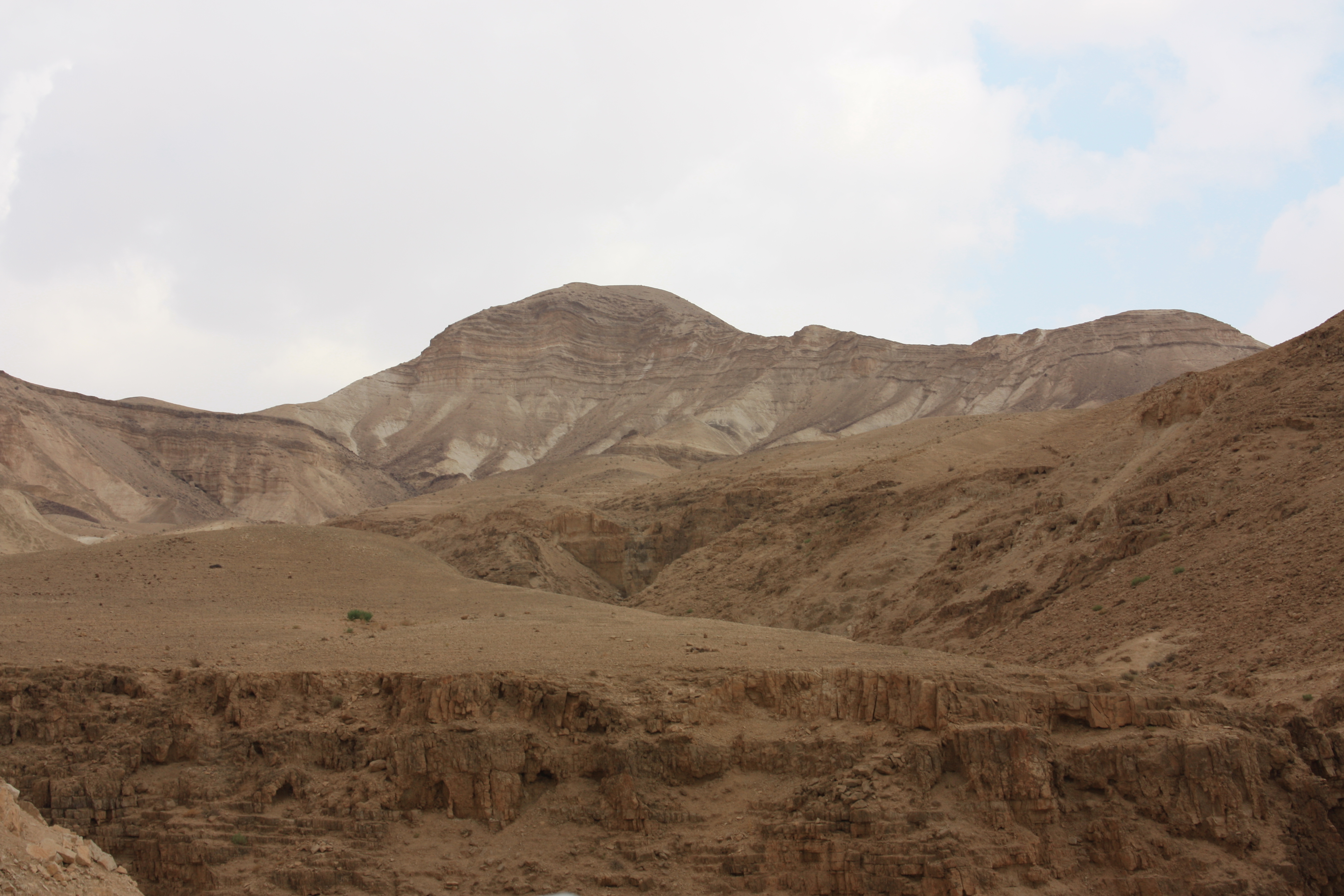
File:Dragot.JPG
Judean Desert. Public domain. Wikimedia Commons.
The 63rd Psalm comes with the following superscription: "A Psalm of David, when he was in the wilderness of Judah." On several occasions in his younger days (1 Samuel 17:29, 23:14, 24:21) David hid out in this mountainous region southeast of Jerusalem; the reference to "the king" in verse 11 may indicate, however, that this was during his flight from Absalom, which went east through the wilderness and across the Jordan.(2 Samuel 15-17) It is a dry, inhospitable place, and prone to severe drought. The modern city of Arad, located at the southern edge of this area, gets no more than 129 mm (5 inches) of rain per year on average, compared to an average of 537 mm (21 inches) in Jerusalem; as of this writing, in November, Arad has had only 9 mm of rain for the year 2012.(Israel Meterological Service) The pictures I have seen remind me of the "badlands" of the U.S. Southwest, where like David and his band, Geronimo and his Apache warriors repeatedly evaded capture by much larger opposing forces.

In this text, however, the Psalmist transfers the desert fugitive's physical isolation and deprivation into the spiritual realm. Psalm 63 comes from a person who has seen both physical danger and spiritual deprivation in the world without God. His need for God's presence is more for the sake of his soul's comfort, than for the body's protection.(Mays, 217)

Stanza 1:
Early, my God, without delay
I haste to seek Thy face;
My thirsty spirit faints away,
Without Thy cheering grace.

The first stanza draws its ideas from first verse of the Psalm, invoking the culturally powerful metaphor of drought (quoted from the King James Version, which was Watts's Bible):
O God, Thou art my God;
Early will I seek Thee:
My soul thirsteth for Thee,
My flesh longeth for Thee
In a dry and thirsty land, where no water is . . .
This harsh reality was an obvious metaphor for the Psalmists, who frequently used dryness and drought to describe spiritual exhaustion and trial. Psalms 22:15 and 32:4 use this idea in the phrase, "My strength is dried up." This idea is also found in the prophets: the vision of the valley of dry bones in Ezekiel 37 emphasizes that "they were very dry."(v. 2) The spiritual application is spelled out in Ezekiel 37:11, "Son of man, these bones are the whole house of Israel. Behold, they say, 'Our bones are dried up, and our hope is lost; we are indeed cut off.'" Spiritual dryness and its relief is also the theme of this beautiful passage in Isaiah:
For I will pour water on the thirsty land, and streams on the dry ground; I will pour My Spirit upon your offspring, and My blessing on your descendants. They shall spring up among the grass like willows by flowing streams.(Isaiah 44:3-4)
It is thus a spiritual, and not a physical need, that haunts Psalm 63; the Psalmist is "hungering and thirsting after righteousness."(Matthew 5:6) He feels his spiritual isolation and his thirst for God's presence so acutely, however, that both "soul" and "flesh" are affected.(Terrien, 462) If only we all had such keen appetites in the spiritual realm!

Stanza 2:
So pilgrims on the scorching sand,
Beneath a burning sky,
Long for a cooling stream at hand;
And they must drink or die.

The second stanza continues to explore the same metaphor, with even more emphasis on the severity of the situation. Now it is not just a "dry and thirsty land,"(Psalm 63:1) but "scorching sand" and "burning sky." In contrast, the presence of God is a "cooling stream," and the stakes are life itself. The human body needs water in some form every day, because it is essential to so many of the processes of the body. We might last for days or even weeks without food, but the effects of dehydration set in within a matter of hours.(Bryant) David's need for God's presence is this critical.

Now, I almost never forget to eat during the day (though that has actually happened), and my consumption of liquid refreshment in the form of coffee and tea is proverbial in my family. But I confess that if I am not careful, most of a day may go by before I realize that I have been too "busy" to spend time in prayer, or in reading God's Word. By contrast, the Psalmist sees his communion with God as a need so pressing that he compares it to finding water in the desert--and when you are in the desert, not much else matters. Would that we all could realize the spiritual desolation that surrounds us in this world, and value the precious time we can spend with God as a matter of spiritual life and death! Jesus gently reminds us of this in the Sermon on the Mount:
Therefore do not be anxious, saying, "What shall we eat?" or "What shall we drink?" or "What shall we wear?" For the Gentiles seek after all these things, and your heavenly Father knows that you need them all. But seek first the kingdom of God and His righteousness, and all these things will be added to you.(Matthew 6:31-33)
Though the primary context of the teaching is our need to put aside worry, it also reminds us of the need to "worry" instead about the things that are really important.

Watts's original has two more stanzas here, omitted in Praise for the Lord. It is an unfortunate omission, in my opinion, especially in the case of the first of the two, which presses the point that arguably underlies the entire Psalm:

I've seen Thy glory and Thy power
Through all Thy temple shine;
My God, repeat that heav'nly hour,
That vision so divine.

Not all the blessings of a feast
Can please my soul so well,
As when Thy richer grace I taste,
And in Thy presence dwell.

These two stanzas derive from Psalm 63:2, with a secondary reference to verse 5:
To see Thy power and Thy glory,
So as I have seen Thee in the sanctuary . . .

My soul shall be satisfied as with marrow and fatness;
And my mouth shall praise Thee with joyful lips.
Here is what the Psalmist desires so earnestly, like a dying man in the desert longing for water: the presence of God. He has been to the sanctuary before and has known the power and glory of God, and longs to keep this ever foremost in his mind. If this Psalm was written during one of David's periods of exile, his desire was probably all the more keen because of deprivation--he could hardly go to such a public place as the tabernacle, and certainly dared not gather with his kinsmen for the appointed festivals. The denial of these opportunities for worship and fellowship made them all the more precious in memory. In the solitude of the wilderness, then, the Psalmist seeks God's presence as an individual appealing for that which he has once known but cannot immediately reclaim. Artur Weiser notes, "It is only against the background of the worshipper's ardent yearning for the presence of God that the experience which fills his heart with joy and gratitude to God is clearly set off in all its magnitude."(Weiser, 454)

There are Christians in this world--perhaps some reading this page--who must put forth a great effort just to gather with the saints for worship. Some are hindered by physical disability; some are forced to drive, ride, or walk great distances; some are even threatened with persecution for the very act of gathering to worship. I hang my own head in shame as I think of them, and then consider how often I arrive late for a worship assembly held just 3 miles from my home, to which I can drive in less than 15 minutes. I would never think of being late to meet with the governor, or the President, or some other important person; can I not at least be sure I am on time to meet with my God, and in the frame of mind to do so?

Part of the problem that so many of us have with worship, I believe, comes simply from a lack of effort--resulting, usually, from a lack of understanding and appreciation of what worship is. When people say, "I didn't get anything out of that service," they may be revealing a fundamental misunderstanding of the transaction that takes place--we come to a worship service primarily to give something, not to get something. Worship is something we "offer to God,"(Hebrews 12:28) presenting ourselves as "living sacrifices."(Romans 12:1) Now, the planners and leaders of a worship service certainly ought to do their best (within God's revealed will!) to make that service as conducive as possible to offering sincere worship, and should not conduct a service in such a way that it becomes a hindrance to the worshipers. But ultimately the responsibility for my worship lies within me, and what I choose to bring to God that day.

Of course there is a natural, reciprocal benefit to giving, even when the gift is so relatively small as our individual worship is to the majesty of God. We do "get something out of worship," even though that is not the reason we do it. Worshiping God restores us to a right frame of mind--humbling us when we have lifted ourselves too high, and raising us up when we have fallen too low. Worshiping God reminds us of the supremacy of His eternal promises over the passing fancies of this world. Worshiping God is a time spent with the very best, purest, and most wholesome Friend the human soul can have. No wonder David so frequently spoke of the "house of the Lord" in the Psalms! "One thing have I asked of the LORD, that will I seek after: that I may dwell in the house of the LORD all the days of my life, to gaze upon the beauty of the LORD and to inquire in His temple."(Psalm 27:4)

Stanza 3:
Not life itself, with all its joys,
Can my best passions move,
Or raise so high my cheerful voice,
As Thy forgiving love.

This stanza adds the thoughts of Psalm 63:3 to the ideas of the preceding stanzas. It is only God's "lovingkindness" that can satisfy the Psalmist's thirsty soul:
Because Thy lovingkindness is better than life,
My lips shall praise Thee.
Psalm 63:3 is a rather unusual statement, toying with a paradox: God's chesed ("lovingkindness") is more important to the Psalmist than his own life, but God's chesed is also the sustainer of that life, as seen in countless instances throughout the Psalms. David adores the lovingkindness of God, not because of the benefit it has been in his life (which was great), but for its own intrinsic worth.(Mays, 218)

The Hebrew word chesed is a powerful concept, not easily translated. The English word "lovingkindness" was actually invented by Miles Coverdale to represent this idea in his translation; this carried through to the King James Version and many of its successors. The Revised Standard, English Standard, and others use the phrase "steadfast love." Interestingly, the writers of the Hebrew Testament apply this term almost exclusively to God's attitude and actions toward His people, and not to human attitudes toward God or toward each other. It is bound up in God's covenant with Israel, and in His unchanging loyalty to His promises and to His own nature. Though His righteousness condemned His people's sins, His sworn love to them was equally great, and mercy was born of the result.(Snaith)

Chesed is therefore much more than a warm, fuzzy feeling of goodwill; the closest comparison that we can understand, perhaps, is the love of a parent for a child. When that love is what it should be, it is warm but also strong, and seeks not just to love and protect but also to guide and counsel. The parent will be disappointed in the child now and then, sometimes grievously so, but the desire for the child's best welfare is still uppermost. That parental love often brings out the noblest, most self-sacrificing deeds we will ever see among our fellow humanity. But God's lovingkindness comes from a place that no human parent can ever know--a position of absolute moral purity and absolute wisdom, knowing all the faults of the other party while being above any of those faults himself. Yet He loves us anyway! Here is the secret of David's joy, the knowledge of which was better to him than even food and drink, or life itself. The "lovingkindness" of God was to the Psalmist the "supreme good" in life.(Weiser, 455)

Stanza 4:
Thus, till my last expiring day,
I'll bless my God and King;
Thus will I lift my hands to pray,
And tune my lips to sing.

Watts's final stanza takes up the theme of Psalm 63:4, the Psalmist's resolve to live a life of praise in view of the refreshing grace of God that he has received:
Thus will I bless Thee while I live:
I will lift up my hands in Thy name.
The memory of his earlier encounter with God makes him long for the experience again, but David may not have been able at that time (perhaps for a long time!) to see God "in the sanctuary."(Psalm 63:2) In the same way, we cannot always be with the people of God, in the "holy temple" of Christian fellowship.(Ephesians 2:21-22) But our memories of those times can go with us, and the knowledge that we have such a refuge changes our perspective on the barrenness of everyday life. Weiser says of David's words, "What the worshipper has come to realize in the house of God does not therefore remain confined to the place of that cultic encounter, but accompanies him right into every sphere of his daily life."(Weiser, 455) The advice of this stanza is an echo of James 5:13, "Is anyone among you suffering? Let him pray. Is anyone cheerful? Let him sing praise." Even if he was alone in the desert, David had the glorious presence of God and His lovingkindness all around him, whenever he entered the his own personal tabernacle of prayer and praise.

In the same way, Paul could rejoice even in his unjust imprisonment in Rome, and exhort the Philippian church to do the same. We should not suppose that Paul enjoyed his suffering in some way; in fact, I can imagine his reaction if his status had changed. Suppose, for example, that Caesar (whichever one it was) had a sudden change of heart and came to Paul's place of imprisonment. "Paul," he says, "you have been treated very unjustly. You are free to go, and here is a letter with my seal declaring you a friend of Caesar and under my protection throughout the empire. You are welcome to stay here in Rome and preach, or I will pay your way to any destination you choose." Would Paul have responded, "No, thanks, I am enjoying these chains far too much?"

But if chains were his fate, Paul rejoiced in the good that he could do, because he had spread the gospel, through his guards, into Caesar's own household.(Philippians 4:22) Like his fellow apostles in Acts 5:41, he rejoiced that he was "counted worthy to suffer dishonor for the name," and had stood his test faithfully. And most of all he rejoiced because he knew his God was always with him. At the end of 2 Timothy, knowing that his life was in far more danger than when he wrote to the Philippians, he could say, "At my first defense no one came to stand by me, but all deserted me. May it not be charged against them! But the Lord stood by me and strengthened me . . ."(2 Timothy 4:16-17) Though we may never face such a trial, may we daily cultivate that relationship with God that reassures us of His presence, whatever the circumstances we face. And may we daily offer our praise and prayer to Him for that blessing!

About the music:

William Dixon (c. 1750?-1825) was a musician just famous enough to leave his mark, but not prominent enough to have all the evidence of his life carefully set down in one scholarly source. The biographical index in the Psalmo-Doxologia (London: Simpson & Marshall, c. 1825) notes that Dixon was born in Liverpool, and was a composer and singer as well as music publisher.(quoted in Glover) This is supported by his self-identification as "William Dixon of Liverpool" in several works published in London (see my works list for Dixon in Worldcat).  Fétis adds that he was an organist as well.(Fétis, "Dixon")

His earliest publication that I have found dates from c. 1777, where he is listed as publisher and engraver. Music engravers made high-quality plates for music printing, working by hand rather than using moveable type. For this reason, I tend to believe the 1750 date of birth rather than 1760 as is often given; it is hard to believe he could have become a professional engraver and publisher by the age of 17.

His whereabouts can be determined only by his publications, which are primarily from Cambridge (with some published in London) up until about 1800. After that date, his publications begin to appear more frequently from Liverpool, suggesting that he may have moved back home. It might just have been a branch office of his publishing enterprise, of course, but one edition of his Euphonia (Liverpool, 1808) bears the subtitle, "for the Congregation of All Saints Church, Liverpool," perhaps suggesting a personal connection.

Based on his publications found in Worldcat, Dixon's compositions appear to have been primarily church music, including Psalm tune settings, original hymn tunes, anthems, and musical settings of the Anglican services. Most of these are arranged for keyboard accompaniment, and some have additional instrumental parts. Several of his publications indicate that they are written "for country choirs." He also wrote and published glees for the Cambridge Harmonic Society.

I have been able to examine a copy of Dixon's c. 1790 Psalmodia Christiana (thanks again to Aaron Kuglin at the Bowld Music Library, Southwestern Baptist Theological Seminary). The music is in the typical open score of the period, with the melody in the tenor, and has numerical "figures" under the bass part--a sort of shorthand that tells a keyboardist what chord to play over each bass note. An interesting feature of the Psalmodia is the inclusion of 50 "fugues," really just short anthems with an emphasis on imitative writing. These are apparently British cousins of the "fuging tunes" of the American colonies.

I have not yet discovered the exact publication in which Dixon's LANESBORO first appeared, though I can confirm it is not in the Psalmodia Christiana. Nor does it appear in the Hymn Tune Index at the University of Illinois at Urbana-Champaign, which compiles several lists covering publications up to 1820. I can also confirm that it is not derived from Dixon's 1790 publication, Six Anthems in Score, Designed for the Use of Country Choirs (thanks to Kirstin Dougan, Mandi Goodsett, and John Wagstaff at the University of Illinois Music and Performing Arts Library for running down these leads).

There is some reason to believe it was not originally composed in the form in which we have it today. I hesitate to depend solely on The Story of the Hymns and Tunes by Brown & Butterworth, but this is the best lead thus far: "It was composed by William Dixon, and arranged and adapted by Lowell Mason."(Brown & Butterworth, 36) Mason cast his net far and wide in his efforts, and adapted the works of numerous minor composers as hymn tunes. The earliest instance I have found of LANESBORO in its current form is from Mason's 1829 edition of the Handel & Haydn Society Collection of Church Music (Boston: Richardson, Lord & Holbrooke). It does not appear, however, in the first edition of 1822.

http://archive.org/stream/bostonhandelhayd1829hand#page/148/mode/2up


References:

Psalms and Hymns of Isaac Watts. Christian Classics Ethereal Library.
http://www.ccel.org/ccel/watts/psalmshymns

"Rainfall observations." Israel Meteorological Service (English site). http://ims.gov.il/IMSEng/Tazpiot/RainObservations/

Mays, James L. Psalms. Interpretation: A Bible Commentary for Teaching and Preaching. Louisville, Kentucky: Westminster John Knox Press, 2011.

Terrien, Samuel. The Psalms: Strophic Structure and Theological Commentary. Grand Rapids, Michigan: Eerdmans, 2003.

Bryant, Charles W. "How long can you go without food and water?" 11 February 2008. HowStuffWorks.com. http://adventure.howstuffworks.com/survival/wilderness/live-without-food-and-water.htm

Snaith, Norman H. "Loving-kindness." A Theological Word Book of the Bible, edited by Alan Richardson. New York: MacMillan, 1951, pp. 136-7. Reproduced at Bible-researcher.com.
http://www.bible-researcher.com/chesed.html

Weiser, Artur. The Psalms: A Commentary, translated by Herbert Hartwell. Louisville, Kentucky: Westminster John Knox Press, 1962.

Glover, Sue. "Who was who." Gallery Music: English Church and Chapel Music of the 1700s and Early 1800s.
http://www.psalmody.co.uk/people/pD.html

"Dixon, William." Fétis, François-Joseph. Biographie universelle des musiciens. Paris: Didot Fréres, 1866, volume 2, page 28.
http://books.google.com/books?id=TQcJAAAAQAAJ&pg=PA28#v=onepage&q&f=false

Brown, Theron, and Hezekiah Butterworth. The Story of the Hymns and Tunes. New York: American Tract Society, 1906.
http://openlibrary.org/books/OL23342340M/The_story_of_the_hymns_and_tunes


Friday, October 26, 2012

Dear Lord and Father of Mankind

Praise for the Lord #122

Words: John Greenleaf Whittier, 1872
Music: Frederick C. Maker, 1887 (REST)

John Greenleaf Whittier (1807-1892) grew up in a Quaker farming family in Massachusetts, and was always strongly grounded in the quiet rural ways of pre-industrial New England. But the image of Whittier as the white-headed old country gentleman, writing folksy ballads, belies his youthful editorial and political work as a militant Abolitionist. His writing was discovered in 1826 by William Lloyd Garrison (1805-1879), who promoted Whittier's early career as an editor and pamphleteer. Whittier even served in the Massachusetts legislature in 1835, where his political views brought considerable attention--he narrowly escaped mob violence after a speech in Concord!

The young Quaker's personal foray into politics was cut short by a breakdown in health from overwork, forcing him to retire to the family farm for a time. By the 1850s, however, most New Englanders had come around toward his views on slavery, and as an early advocate of Abolition by peaceful, legislative means, Whittier was held in high regard. Along with literary titans such as Emerson and Longfellow, he was part of the founding generation of writers for The Atlantic Monthly in 1857.(Cluff)

Though Whittier's lengthy poem "Snow-Bound" is generally considered his literary masterwork, it is through hymn adaptations that he is most widely known today. Ironically, he was somewhat bewildered at the success of these repurposed verses:
I am really not a hymn-writer, for the good reason that I know nothing of music. Only a very few of my pieces were written for singing. A good hymn is the best use to which poetry can be devoted, but I do not claim that I have succeeded in composing one.(quoted in Julian, 1278)
His peers, and following generations, have begged to differ. Julian lists 33 hymns that were in common use by the end of the 19th century, and at least two--"Dear Lord and Father of Mankind" and "Immortal Love forever full" (PFTL #326) are still found in many hymnals today.(Julian, 1278) Most of these were excerpted from longer works; "Dear Lord and Father of mankind" is the final six stanzas of the 17-stanza poem titled "The Brewing of Soma," published in The Atlantic Monthly volume 29, issue 174 (April 1872), pages 473-475.

The first six stanzas of "The Brewing of Soma" are a reimagining of the ancient Vedic Indian practice of imbibing soma, a drink that was probably not actually an alcoholic brew but rather the clarified essence of a psychedelic mushroom. In some Vedic rituals, soma was offered to the gods, who were believed to be empowered by its effects; the priests and people also partook and received ecstatic visions.(Mahony)

This seems a long way from the hymn text we know! But in the next five stanzas, the middle portion of the poem, Whittier compares the artificially induced passions created by soma to the misguided attempts of Christians to create a meaningful relationship with God through the use of artificial innovations. He compares these practices to each other--Christian and non-Christian, Western and Eastern--and finds them all to have been mere attempts "to bring the skies more near, / Or lift men up to heaven," by our own efforts.

It is important here to understand traditional Quaker worship as Whittier knew it. In the "unprogrammed worship" or "waiting worship" still practiced by conservative Quakers, congregants gather in silence and simply wait for the Holy Spirit to move someone to speak. This may be a prayer, a Scripture reading, a song, or a devotional message; no one knows until it happens. If no one is moved to speak, a service may consist entirely of sitting in silence, "waiting on the Lord."("Friends' Worship") In earlier centuries, this was thdo predominant mode of worship among Quakers, but during the Second Great Awakening of the 19th century, many began to embrace the fervor of the Holiness movement. Whittier complained to a friend that "Quakerism has run into Methodism."(Herman)

To the reserved New England farmer, there was a world of difference between a group of equals waiting quietly for the Spirit to speak, and a crowd being whipped into a frenzy by a professional revivalist. The final stanza of the middle section of "The Brewing of Soma" reads:
And yet the past comes round again,
And new doth old fulfil;
In sensual transports wild as vain
We brew in many a Christian fane
[temple-DRH]
The heathen Soma still!
The author of "Dear Lord and Father of Mankind" was mourning not only the busyness and noise of everyday life, but also the busyness and noise which can all too easily become a substitute for true spiritual worship. I have always found the Quakers interesting, though we disagree on many points. Historically they have been willing to put their beliefs into practice, and to suffer the consequences for going against the mainstream. And though I do not agree with their ideas about the nature and means of the Spirit's leading, I wholeheartedly agree that our worship ought to begin from a relationship with God that listens to His Spirit and responds to Him in the ways that He directs.

Stanza 1:
Dear Lord and Father of mankind,
Forgive our foolish ways!
Reclothe us in our rightful mind,
In purer lives Thy service find,
In deeper reverence, praise.

Scripture has a great deal to say about fools and foolishness, but nowhere, I think, is the subject of foolishness in worship addressed so directly as in this eloquent passage from Ecclesiastes:
Guard your steps when you go to the house of God. To draw near to listen is better than to offer the sacrifice of fools, for they do not know that they are doing evil. Be not rash with your mouth, nor let your heart be hasty to utter a word before God, for God is in heaven and you are on earth. Therefore let your words be few.(Ecclesiastes 5:1-2)
A dear older friend of mine served in the U.S. Army during the Second World War, and vividly recounted the day that King George VI visited the troops where he was stationed in northern Africa. The British soldiers camped next to the Americans lined the road, shouting "God save the King!" and other such cheers as the motorcade passed. My friend's commanding officer thought it would be clever if the Americans did something different, and so when the royal car passed they all shouted on cue, "Yaaaayyyy, George!" According to my eyewitness, the King's facial expression was priceless.

Most of us have a better sense of appropriateness when addressing human dignitaries. Why, then, would anyone suppose that we could approach the King of Kings with any less respect, or concern for appropriate behavior? If I am writing a formal letter to some person in high government office, I will check a dictionary or almanac to be sure of the correct form of address. Why wouldn't I give the same attention to God's word in an effort to learn how I should address Him in worship? Here is Whittier's meaning, I think, in the expression, "foolish ways." Like the unfortunate American officer, people often wish to approach God in some way of their own invention, because it appeals to them more, and are oblivious to the question of what God would have them do.

Often, I believe, this comes from a sincere desire for an intimate experience of the presence of God in their worship. Unfortunately, we humans are too prone to mistaking one feeling for another. We confuse excitement with passion, and exhilaration with devotion. Now, if we feel nothing in our worship, there is obviously something wrong; but on the other hand, just having a warm spiritual feeling does not mean we are one bit closer to God, or any more pleasing to Him. I have seen cold, dead worship (at least it appeared so to me, which an important caution to remember), but I have also seen very enthusiastic worship in which people were whipped into a frenzy of devotion, week after week, yet with little apparent effect on the lifestyles I saw the rest of the time. It is useless to have a cold, dead faith, but it is equally useless to drink the soma of an induced emotional high and believe it is worship.

Of course there are many other things in this world that become soma to the multitudes who are looking for meaning and fulfillment. Sometimes it is actually a literal drug; sometimes it is an abuse of the passions of the flesh, such as food, or sex, or the desire for material things. Sometimes we even use good and noble things, such as love of friends and family, as a soma that gives our lives meaning. But in the end these things are not solving the fundamental need of the human soul, to find its Creator.

So what is Whittier's alternative? He would first have us "reclothed in our rightful minds." The attitude with which we approach worship is just as important as the content of the worship itself. This is much of the message in Eccesiastes 5:1-2, quoted above: remember who God is, and who you are. When Moses heard the voice from the burning bush announce the presence of the Lord, he "hid his face, for he was afraid to look at God."(Exodus 3:6) When Isaiah saw the vision of the Lord in the temple, he cried out, "Woe is me, for I am undone! Because I am a man of unclean lips, and I dwell in the midst of a people of unclean lips; for my eyes have seen the King, The LORD of hosts."

Now, as Christians we know that Jesus came to open a "new and living way" into the presence of God by His blood,(Hebrews 10:20) and that because of this we can "with confidence draw near to the throne of grace, that we may receive mercy and find grace to help in time of need."(Hebrews 4:16) But though we are able to come before Him "with confidence" (KJV "boldly"), that does not mean we are free to come before Him flippantly or carelessly. We must "draw near with a true heart in full assurance of faith,"(Hebrews 10:22), worshiping the Creator "in spirit and in truth."(John 4:23)

Whittier defines his objective a little further in the wish that we would "in purer lives Thy service find." Hebrews 10:22 says in full: "Let us draw near with a true heart in full assurance of faith, with our hearts sprinkled clean from an evil conscience and our bodies washed with pure water." Few of us, if we have a choice, will go to the worship assembly unwashed, with our hair unkempt, and wearing dirty clothes; we ought to take more concern, though, for the state of the inward person! The high priests of the Hebrew dispensation wore a headdress bearing a gold plate engraved with the words, "Holiness to the LORD."(Exodus 28:36) This was an outward symbol of the spiritual reality, and showed the priest's complete dedication to God's service. May God engrave that on our hearts and minds so that we never forget it.

Holiness seems to have at least two sides--purity, and dedication to service. The priests of the Hebrew temple, and even the furnishings of the temple, illustrate both of these. They were to be pure, free from uncleanness. The high priests were not allowed to touch a dead body, even of a near family member.(Leviticus 21:10-11) The priests and the temple were set aside in this way for a reason--they were to serve God in a special way. The entire tribe of Levi, in fact, was for the most part supported by the other tribes, because they were meant to serve God full-time. We need to recognize that we too are called to personal purity, and are set apart for God's service.

The Quaker ethic placed a great emphasis on holiness put into practice in our dealings with fellow humanity. William Penn said,
And most certainly, as men grow in grace, and know the anointing of the Word in themselves, the dispensation will be less in words (though in words) and more in life; and preaching will in great measure be turned into praising, and the worship of God, more into walking with, than talking of God: for that is worship indeed, that bows to his will at all times, and in all places: the truest, the highest worship, man is capable of in this world.(Primitive Christianity Revived, chapter 10, section 6; italics in original)
It was no accident that Penn built a Quaker colony, Pennsylvania, which became a beacon of religious tolerance to the world. No accident, either, that the Quakers were at the forefront of the anti-slavery movement on both sides of the Atlantic. Of course good works do not replace worship, any more than worship replaces good works; they are interdependent. A life fully devoted to serving God should lead to devoted worship as well, and worship in spirit and truth should cause us to serve God in our daily lives with the same spirit and truth.

Whittier also calls us to find, "in deeper reverence, praise." This seems to be the perennial problem of worship; if there is sufficient reverence in the first place, then the actions and intentions will usually follow God's wishes as well. Hebrews 12:28 instructs us, "Let us offer to God acceptable worship, with reverence and awe." If Cain had possessed enough reverence and awe, would he have offered an unacceptable sacrifice to God?(Hebrews 11:4) If Nadab and Abihu had possessed enough reverence and awe, would they have used "unauthorized fire" in the temple?(Leviticus 10:1) If the church at Corinth had possessed enough reverence and awe, would they have corrupted the Lord's Supper?(1 Corinthians 11) Let us first understand Whom it is we worship, and we will know to listen to His wishes, and to fulfill them with the sincerest efforts of our hearts.

Stanza 2:
In simple trust like theirs who heard
Beside the Syrian sea
The gracious calling of the Lord,
Let us, like them, without a word,
Rise up and follow Thee.

This stanza comments on the remarkable incidents of the calling of the apostles. Whittier is likely referring to Matthew 4:18-22, in which Jesus formally called Peter and Andrew, and then James and John. In each case the apostles are said to have followed Jesus "immediately," leaving their fishing business on the spot. In other passages we find that there was some interaction between these individuals beforehand; John 1:40-42 tells us that Andrew had heard Jesus teaching and went to get Peter, whom he introduced to the Lord at that time. Luke 5:1-11 gives us a more detailed account of the call of the four fishermen, including the miraculous catch of fish. In this account we find that Peter, as we would expect, did not follow Jesus "without a word"--his response to Jesus was, "Depart from me, for I am a sinful man, O Lord."(Luke 5:8)

But his attitude of heart was one of quiet submission, and when Jesus calmed his fears, Peter rose up and followed. Jesus knew he was a sinful man when He called him; all of the apostles, of course, were sinful men. The important thing was, Peter knew he was a sinful man, and thus in an appropriate humility he listened to his Lord and obeyed. We have a similar example in the young Samuel, who at the advice of Eli responded to the Lord's nighttime call, "Speak, Lord, for your servant hears."(1 Samuel 3:10) Little Samuel heard an earful that night, and it must have been a heavy burden to bear; but he served the Lord faithfully through a difficult era in Israel's history. He set the first example of the priest and prophet standing up against the king,(1 Samuel 15) because he listened to God rather than to men.

There is a timeworn proverb that my children know by heart: "You have two eyes, two ears, and only one mouth--and there's a reason for that." We need to listen to God's word, and to watch carefully for the opportunities He sends us to do good. We are not called to such a high station as the apostles, but we are called to some station, and whatever work the Lord gives us is important because it is serving Him. As an old boss of mine used to say (I suppose all bosses say this), "We need a lot less talking and a lot more doing."

Another great example of this attitude is found in Andrew, one of the most under-recognized of the apostles. Before the feeding of the five thousand, Jesus questioned His disciples about how they would feed the multitude--testing their faith.(John 6:6) Philip probably represented the majority when he spoke up and declared the task impossible; but Andrew turned up with the boy who had the five barley loaves and two fish. Andrew's faith was imperfect--he still asked, "What are these for so many?"(v. 9) But while others were standing around complaining, Andrew was looking about for a way to solve the problem. He did not question the Lord's directions, but simply did the best he could to obey and left the rest to Jesus.

Stanza 3:
O Sabbath rest by Galilee!
O calm of hills above,
Where Jesus knelt to share with Thee
The silence of eternity
Interpreted by love!

In Whittier's original poem there is another stanza here, which is included in some hymnals. It continues the theme of the preceding stanza:

With that deep hush subduing all
Our words and works that drown
The tender whisper of Thy call,
As noiseless let Thy blessing fall
As fell Thy manna down.

I have known people, and you probably do too, who cannot abide silence and solitude. They must have some kind of activity, and some kind of noise, or they are uncomfortable. I understand why people may turn on the radio or television when they are home alone, when the house seems "too quiet." And there are certain kinds of work that are very much aided by the mental diversion of listening to music, or news, or sports. (I will always associate the days of writing my dissertation with the 1996 baseball season and the Texas Rangers.) But modern society has come to expect a constant background of distracting sights, sounds, and interactions, and I am afraid I know why. When we are alone and all is quiet, we can hear ourselves think.

When we take the time to think, we often become aware of things that we would rather avoid. We may begin to wonder about where our lives have taken us. We may begin to think about our relationships with other people. We may even contemplate our own mortality. We might call into question our entire course of life if we are not careful! These questions make us uncomfortable, but Christians know that this is exactly the kind of introspection that Scripture urges upon us for our own good. And for Christians, no matter how uncomfortable such self-examination may make us, there is the reassurance that we do in fact have answers to the questions and solutions to the problems that solitude forces us to face.

Psalm 46:10 adjures us, "Be still, and know that I am God." If we take the time to stop and think about who God is, to really try to comprehend (however imperfectly) what He has told us of himself, it sets us on a right footing for everything else. It is difficult to focus our minds, but choosing the time and place helps. An early morning walk before sunrise is a good opportunity to observe God's creation without as many distractions of the man-made world. We might look at the moon and the stars, and think of their immense age and distance from us. We might listen to the wind or watch the clouds go by, both of which go unnoticed during our busy workdays but are always there, moving about this planet in systems of such complexity that we can never quite predict what they will do next. The great Levite singer Asaph said in Psalm 77:12, "I will ponder all Your work, and meditate on Your mighty deeds." But these things are "His works, and not Himself," as Augustine so eloquently put it.(Confessions, 3.6.10) Our sun annihilates a little more than 4.5 million tons of matter every second to produce the heat and light that keep us alive, through processes that are still not completely understood; but our God is the one who created that body.

Quiet study and meditation also helps us to remember who our God has proven himself to be in His dealings with His people. In Psalm 143:5, David said, "I remember the days of old; I meditate on all that You have done." When we remember God's faithfulness and providence, we can put a better perspective on our problems. The author of the great 119th Psalm states in verse 23 that, "Even though princes sit plotting against me, Your servant will meditate on Your statutes." Quiet introspection in the light of God's word will also keep us on the right path. God instructed Joshua, at the beginning of that worthy man's leadership over Israel, "This Book of the Law shall not depart from your mouth, but you shall meditate on it day and night, so that you may be careful to do according to all that is written in it."(Joshua 1:8)

The third stanza of Whittier's poem recalls the devotional life of Jesus, who spent frequent periods in the sole company of His Father.(Mark 1:35-38, Luke 6:12) In Matthew 26:36-46 we find Jesus praying fervently in Gethsemane, and receiving the comfort of ministering angels. It is sadly ironic that Judas chose this place to betray Jesus into the hands of His enemies--because Judas knew Jesus often went there for this purpose.(John 18:2) Even Jesus found it needful to seek quiet and solitude to commune with His Father; how much more do we?

Looking again at Whittier's primary context, I wonder if many of us have become afraid of silence in worship. If we worshipers become bored during a few minutes (or seconds?) of silence, I wonder what that says about the desire to focus on God. But I have seen many worship services among other religious groups in which the organ or piano is playing almost constantly, as though they cannot afford to leave people unattended in their own thoughts.

Among the Churches of Christ I have occasionally encountered the practice of singing during the Lord's Supper. I am not saying this is wrong, or that it could not be done in a good way; but the silence we have traditionally observed during this time is precious to me. When I was a child it made me realize the deep solemnity and importance of this Part of worship. Now that I am a Christian it is an aid in my private self-examination before partaking.(1 Corinthians 11:28)

Stanza 4:
Drop Thy still dews of quietness,
Till all our strivings cease;
Take from our souls the strain and stress,
And let our ordered lives confess
The beauty of Thy peace.

Whittier's "Brewing of Soma" has one more stanza in conclusion, which is used in many hymnals (the selection and ordering of the stanzas varies greatly from editor to editor):

Breathe through the heats of our desire
Thy coolness and Thy balm;
Let sense be dumb, let flesh retire;
Speak through the earthquake, wind, and fire,
O still, small voice of calm!

Sometimes our lack of quiet and solitude is not from choice, but from the necessity pressed upon us in a hectic, fast-paced world. A humorous example of this that I have heard from my parents concerned one of our elders from the Church of Christ in my home town in Oklahoma. It had been a tremendously busy day for him with many interruptions, but finally our families were able to sit down together to eat. As we were in this elder's home, we waited until he finally got away from the telephone and came to the table to offer thanks for our food. He sat down, bowed his head, and said, "Hello?" as though he were answering the phone again! The good man was simply frazzled by a demanding day.

"God is not a God of confusion, but of peace."(1 Corinthians 14:33) Yet how hard it is to clear away the confusion that results from the distractions of life! But if we cannot find time to be alone with God, we need to make some changes. Certainly we can examine our lives and look for those things that we can simplify, or even delete, in order to have time for something so important. Often it is just a matter of determining to take the time. David found this place, in spite of his stressful and demanding life (see 1st and 2nd Samuel), as seen in this little gem of a Psalm:
O LORD, my heart is not lifted up;
My eyes are not raised too high;
I do not occupy myself with things too great and too marvelous for me.

But I have calmed and quieted my soul,
Like a weaned child with its mother;
Like a weaned child is my soul within me.

O Israel, hope in the LORD from this time forth and forevermore.

(Psalm 131)
Sometimes, however, our best efforts at finding quiet and solitude are thwarted by circumstances beyond our control. (I wonder, however, if there is not a more diabolical agency behind this!) When we are gripped by stress and cannot seem to find peace, we can take comfort in the fact that the same Lord whose help we seek is the one who once told a stormy sea, "Peace, be still!"(Mark 4:39) Søren Kierkegaard related this idea in his poem, "For Inward Peace." The composer Michael Rickelton, a former student of mine (who obviously overcame that handicap), created a beautiful choral setting of this text that has been performed widely.
Calm the waves of this heart, O God; calm its tempests.
Calm yourself, O my soul, so that God is able to rest in you, so that God’s peace may cover you.
Yes, You give us peace, O God, peace that the whole world can never take away.
The apostle Paul noted in Philippians 4:11 that, "I have learned in whatever situation I am to be content." Paul had more reason than most of us to be stressed (see 2 Corinthians 11), but he had found that "peace of God that passes understanding."(Philippians 4:7) Paul, though in prison and under threat of death, through his "ordered life confessed" this peace to all the world and for all time. God help us to calm our spirits and find that inner peace, both for our own sakes, and for the sake of an out-of-control society that is desperate for such relief.

There is an element of this hymn found in two of the stanzas unused in Praise for the Lord, that reflects the Quaker view of "inner light" or direct personal revelation from the Holy Spirit. The "still small voice of calm" in the final stanza of Whittier's poem, and an earlier stanza's phrase "tender whisper of Thy call" are the real point of the silence in Quaker worship. But though I do not share Whittier's view of a continuous, personalized revelation, we certainly need to listen so attentively to the Spirit's words that are unmistakably revealed to us in Scripture. We need to train our attention on the Spirit's providential work in our lives, both to strengthen us and to use us as His instruments of good. The "still, small voice" was what told Elijah to get up from his discouragement and self-pity and return to his ministry with a new perspective.(1 Kings 19) Let us take the time, or make the time, to be quiet in our thoughts and listen to our Father. And let us then say with our Savior, "Not my will, but Yours, be done."(Luke 22:42)

About the music:

Frederick Charles Maker (1844-1927) was born, lived, and died in Bristol. He was a professor of music at Clifton College, and was engaged as organist by a series of  congregations of the Free Congregational fellowship.(Cyberhymnal) A search of Worldcat.org reveals that he published anthems, hymns, and sacred cantatas, as well as numerous secular works for piano, music theory texts, and vocal exercises. He even wrote an operetta on the story of Goldilocks and the three bears (1912).

His list of tunes represented in the Hymnary.org database (most of them with page scans or PDFs) shows that two of his works far outstripped the others in popularity--REST (also sometimes called ELTON), the tune under consideration here, and MAKER, the common tune for "Beneath the cross of Jesus." Both of these have the distinction of having become firmly associated with their respective texts; in the U.S. it is rare to find Whittier's hymn set to any other tune, though I understand that REPTON, based on a melody by Sir Hubert Parry, is often used in Great Britain and the Commonwealth nations. Frederick Maker originally composed REST for the Congregational Hymnal (London, 1887) edited by George S. Barrett.(Hymnal 1940 Companion, 271)

Maker's style in this hymn setting is squarely within Victorian Romanticism, full of chromatic turns of melody and richly chromatic harmonies underneath. Coincidentally, both REST and MAKER begin with a similar chromatic neighboring tone--REST with MI-MI-MI-RI-MI ("Dear Lord and Fa-ther"), and MAKER with SOL-SOL-SOL-FI-LA-SOL-MI ("Be-neath the cross of Je-sus"). What distinguishes Frederick Maker's use of this style is that he does it so well--though it was a somewhat cliched style even at the time, his broad education in music probably gave him a perspective that helped him not be caught up in chromaticism for chromaticism's sake. He is dramatic without being syrupy.

A particularly effective touch is the chromatic descent in the melody through the end of the first phrase into the beginning of the second. Here the tune falls by half-step on each successive note of the words "man-kind, For-give." The raised chromatic note on "-kind" is the leading tone to the dominant, which is the goal of the cadence at the end of the second phrase; but the following note on "For-" unexpectedly moves down instead of up, deflating the sense of striving toward the dominant. There is a very clever echo of this idea at the end of the tune as well--on the words, "deep-er rev'-rence, praise," the tenor follows a similar descending half-step pattern, one of the most memorable moments in the music.

The middle part of the hymn tune, the third and fourth phrases, is built around a modified melodic and harmonic sequence. The third phrase, MI-MI-FA-SOL-DO-DO-TI-LA ("Take from our souls the strain and stress") is echoed by the fourth, (LA-LA-SOL-FA-FI-SOL-FA-MI ("And let our ordered lives confess"), at least in the closing descending notes, but the opening three notes are inverted (LA-SOL-FA descending instead of MI-FA-SOL ascending). The bass line emphasizes these opening three notes each time, following them in parallel 3rds an octave below; this makes the bass line a melodic sequence in itself, and to some extent makes the harmonic progressions of the two phrases sequential as well.

But to have all these wonderful flowing lines in the melody, tenor, and bass, someone has to pay the price--and thus was born one of the most boring alto lines ever written. The alto cycles endlessly through the notes DO, TI, and RE, with one solitary DI (DO-sharp). Hopefully the cleverness of the harmonies shifting around this fixed point is compensation enough for such mistreatment!


 References:

Cluff, Randall. "Whittier, John Greenleaf." American National Biography. New York: Oxford University Press, 1999, volume 23, 320-322.

Julian, John. A Dictionary of Hymnology. New York: Scribner, 1892.
http://books.google.com/books?id=AC1RAAAAYAAJ

Whittier, John Greenleaf. "The Brewing of Soma." The Atlantic Monthly volume 29, issue 174, pages 473-475. Hosted at Cornell University, Making of Americahttp://digital.library.cornell.edu/cgi/t/text/pageviewer-idx?c=atla&cc=atla&idno=atla0029-4&node=atla0029-4%3A10&view=pdf&seq=479&size=50

Mahony, William K. "Soma." Encyclopedia of Religion. New York: MacMillan, 1995, volume 13, pages 414-415.

"Friends' Worship." Conservative Friend. Stillwater Monthly Meeting of Ohio Yearly Meeting of Friends. http://www.conservativefriend.org/friendsworship.htm

Herman, Susan. "The Brewing of Soma." John Greenleaf Whittier: Essex County's Famous Son. Danvers, Massachusetts: North Shore Community College.
http://myweb.northshore.edu/users/sherman/whittier/quaker/brewingofsoma.html

Penn, William. Primitive Christianity Revived. 1696. Online edition from an 1857 reprint by Street Corner Society. http://www.strecorsoc.org/penn/pcr_10.html

Augustine. Confessions, translated by Albert C. Outler. Wikisource.org. http://en.wikisource.org/wiki/The_Confessions_of_Saint_Augustine_(Outler)

"Frederick Charles Maker." Cyberhymnal. http://www.hymntime.com/tch/bio/m/a/k/maker_fc.htm

The Hymnal 1940 Companion. New York: Church Pension Fund, 1949. http://hdl.handle.net/2027/uc1.b3658273

Friday, October 5, 2012

Do All in the Name of the Lord

Praise for the Lord #121

Words: Austin Taylor, 1916
Music: Austin Taylor, 1916

Austin Taylor (1881-1973) was one of the most important hymnal editors, songwriters, and music teachers among the Churches of Christ in the U.S. during the 20th century. Born in central Kentucky, he came to Sherman, Texas as a child and began leading singing schools and writing gospel songs as a young man. Together with G.H.P. Showalter, he was the longest-running editor of the hymnals published by Firm Foundation in Austin, Texas. He also co-founded the Texas Normal Singing School, the oldest such institution still in existence among the Churches of Christ.

This song first appeared in New Songs of Praise (Austin, Texas: Firm Foundation, 1916), one of the earliest songbooks co-edited by Taylor and Showalter.(Copyright Entries, 1211) A search of Hymnary.org shows that "Do all in the name of the Lord" became a standard not only in the Firm Foundation hymnals, but also in those of the Quartet Music Company in Fort Worth, Texas, as well as the songbooks edited by Marion Davis, an editor and songwriter from Fayette, Alabama. Though it has probably always been a little more popular in its native Texas, the song has become well-known among the Churches of Christ in this country generally. It is an excellent example of a "teaching and admonishing" song,(Colossians 3:16) and one of the few we have on this particular subject.

Stanza 1:
Whate'er you do in word or deed,
Do all in the name of the Lord;
Do naught in name of man or creed,
Do all in the name of the Lord.

Refrain:
Do all in His name,
Do all in the name of the Lord;
In word or deed, as God decreed,
Do all in the name of the Lord.

The fundamental idea of the song, of course, is Colossians 3:17--"And whatever you do, in word or deed, do everything in the name of the Lord Jesus, giving thanks to God the Father through Him." The key question about this verse is, what does "in the name of the Lord Jesus" mean? The original Greek phrase translated "in the name" is ἐν ὀνόματι (en onomati), and occurs in the following passages. I have tried to group these together by the sense in which they seem to be used, which hopefully will illuminate the manner in which this phrase is employed in the New Testament.
  • "Blessed is He that comes in the name of the Lord."(Matthew 21:9, cf. 23:39)
  • "I am come in My Father's name [ἐν τῷ ὀνόματι τοῦ πατρός μου (en to onomati tou patros mou)], and you receive Me not; if another shall come in his own name [ἐν τῷ ὀνόματι τῷ ἰδίῳ (en to onomati to idio)], you will receive him."(John 5:43, cf. 10:25)
  • "But the Comforter, the Holy Spirit, whom the Father shall send in My name [ἐν τῷ ὀνόματι μου (en to onomati mou)] . . ."(John 14:26)
  • "[Paul] preached boldly at Damascus in the name of Jesus."(Acts 9:27, cf. v. 29)
In each of these statements one person is representing another, speaking and acting "in the name of" that person. Jesus came in His Father's name; after Jesus' earthly ministry was complete, the Holy Spirit came in the name of Jesus; and Paul, one of Jesus' specially appointed messengers, preached the Spirit-inspired gospel in the name of Jesus. Paul (like all Christians) was an "ambassador" empowered to speak in the name of another; the power and authority of the greater is invested in a representative, who is responsible to act and speak on that person's behalf.(2 Corinthians 5:20) In this sense, to "do all in the name of the Lord" means we should always remember, in everything we say or do, that we are representatives of Christ's will and message for the world.

But Jesus brought out another side of this responsibility in John 5:43, when He noted the importance of the source of authority, and the loyalty to be shown to that source. When Jesus said He came in His Father's name, He preceded that statement by emphasizing His dependence on His Father's authority: "Truly, truly, I say to you, the Son can do nothing of His own accord, but only what He sees the Father doing. For whatever the Father does, that the Son does likewise."(John 5:19) Jesus spoke and acted "in the name of the Lord" by doing what was within His Father's will. This was the proof of the authority of His words: "For the works that the Father has given Me to accomplish, the very works that I am doing, bear witness about Me that the Father has sent Me."(John 5:36) "Do all in the name of the Lord" means to represent the Lord to the world, but only in words and deeds that are in submission to His will.
  • "In His name [ἐν τῷ ὀνόματι αὐτοῦ (en to onomati autou)] shall all the Gentiles trust."(Matthew 12:21)
  • "That believing you might have life in His name [ἐν τῷ ὀνόματι αὐτοῦ (en to onomati autou)]."(John 20:31)
  • "Holy Father, keep through Your name [ἐν τῷ ὀνόματί σου (en to onomati sou)] those whom You have given Me"(John 17:11, cf. v. 12)
  • "You are justified in the name of the Lord Jesus"(1 Corinthians 6:11)
  • "And he commanded them to be baptized in the name of the Lord."(Acts 10:48)
In these passages we see that "in the name of the Lord" we find hope, life, salvation, justification, and security. The "name" represents the power and authority of the Lord as a source of protection. If we "do all in the name of the Lord," we are speaking and acting in ways that are in subjection to, in harmony with, and thus empowered by, the will of our God.
  • "In My name [ἐν τῷ ὀνόματι μου (en to onomati mou)] they shall cast out demons, etc."(Mark 16:7)
  • "Even the demons are subject to us through Your name [ἐν τῷ ὀνόματί σου (en to onomati sou)]"(Luke 10:17)
  • "In the name of Jesus Christ, rise up and walk."(Acts 3:6)
  • "By what power, or by what name [ἐν ποίῳ ὀνόματι (en poio onomati)], did you do this?"(Acts 4:7)
  • "By the name of Jesus . . . this man stands here before you whole."(Acts 4:10)
  • "Anointing him with oil in the name of the Lord."(James 5:14)
Here we see the source of the miraculous manifestations of power and authority in the early church. The exchange in Acts 4, in particular, shows the apostles' concern to attribute their works of power to the true source. For them, "doing all in the name of the Lord" meant recognizing that it was in Christ, and not in themselves, that this power resided. When it came to miracles, if it was not done "in the name of the Lord," it was not done at all.
  • "Whatever you shall ask in My name [ἐν τῷ ὀνόματι μου (en to onomati mou)], that will I do"(John 14:13, cf. 14:14, 15:16, 16:23-26)
  • "Giving thanks . . . in the name of our Lord Jesus Christ"(Ephesians 5:20)
These two passages speak of praying "in the name of" Jesus. We understand this first, of course, as praying through Jesus to the Father: Jesus is our "Advocate with the Father,"(1 John 2:1) "in whom we have boldness and access with confidence through faith in Him."(Ephesians 3:12) Yet we understand that "ask in My name" is not a magical key to getting whatever we want, else I would have received that model airplane I specifically prayed for when I was about 10 years old. James 4:3 clarifies the situation: "You ask and do not receive, because you ask wrongly, to spend it on your passions." Asking in the name of Jesus also means to ask for that which is within the bounds of His authority and will for us, and to ask from a position of submission to that authority in the first place.
  • "Now we command you brethren, in the name of our Lord Jesus Christ, that you withdraw yourselves from every brother that walks disorderly"(2 Thessalonians 3:6)
  • "In the name of the Lord Jesus Christ, when you are gathered together . . . deliver such a one to Satan"(1 Corinthinas 5:4-5)
Paul gave these instructions to two different congregations, both of which were facing the most sobering and difficult task any group of Christians can encounter--separating another Christian from fellowship. In both cases the apostle solemnly invokes "the name of our Lord Jesus Christ," reminding them of the absolute necessity of obeying His will in the matter, but also of the awful responsibility they shoulder by acting in His name. To "do all in the name of the Lord" in this case would mean to carefully and conscientiously carry out His will, doing the right thing, in the right way, for the right reason.
  • "Whoever shall give you a cup of water to drink in My name [ἐν τῷ ὀνόματι μου (en to onomati mou)]"(Mark 9:41) 
  • "If you be reproached for the name of Christ . . ."(1 Peter 4:14)
  • "That at the name of Jesus every knee should bow . . ."(Philippians 2:10)
These passages remind us again that to "do all in the name of the Lord" is to represent Him to those outside His body in a way that is in accordance with the power and authority of His name. We are representing Him in some fashion, for good or bad, every day; therefore we should strive to make our "words and deeds" those that will bring respect to His name. (Even reproach is a form of respect, depending on the person from whom it comes!) As Philippians 2:10 tells us, every soul will bow someday in the name of Jesus; let us be those who do so now, and encourage others to do so, while there is still time to repent!

We in the Churches of Christ have sometimes been maligned for quoting Colossians 3:17 as a proof-text for the necessity of authority in doctrine and practice. After examining the use of the expression "in the name of the Lord," I agree that it is a mistake to think it means no more than "by the authority of"--but it is a bigger mistake to think it means less than that! "Do all in the name of the Lord" simply cannot mean, "Do whatever you want, and say it is in the name of the Lord." No authority on earth would permit its representative to act in such a fashion, and no authority in heaven has ever done so!

In Acts 4:7, when Peter and John were brought before the high priest and other Jewish religious leaders for their preaching of Jesus, the question was put: "By what power, or by what name [ἐν ποίῳ ὀνόματι (en poio onomati)], did you do this?" This is the same phrase as in Colossians 3:17, except of course for the interrogative, "What?" Here we have the equating of "by the power of" and "by the name of"--the New Living Translation (in a rare occasion of warranted paraphrase) reads, "In whose name did you do this?" It was an echo of the same rulers' question to Jesus in Matthew 21:23, "By what authority [ἐν ποίᾳ ἐξουσίᾳ (en poia exousia)] do you do these things?"

On both these occasions we have to give credit to the high priest, rulers, and scribes--in my opinion, these were the most worthwhile words ever recorded from their lips. As Gamaliel pointed out, they had seen would-be messiahs before.(Acts 5:36-37) Anyone making such claims and doing such works as did Jesus and His followers deserved a careful examination. And notice that in Matthew 21, Jesus did not scoff at the question of seeking a ground of authority in religious matters. Instead He countered his opponents with the question, "The baptism of John, from where did it come? From heaven or from man?"(Matthew 21:25) Jesus' point, of course, was that His accusers were unwilling to face the consequences of the answer; but they were all in agreement that the authority behind a religious teaching or practice mattered!

In view of the majestic power and solemn authority of "the name of the Lord," the mention of "man or creed" in the third line of this stanza rightly pales in comparison. How many churches have been divided--and to be brutally honest, how much blood has been shed--over the words of uninspired men? Yet when we stand before the Judgment, all the confessions and creeds written throughout history will not answer to the Book that will be opened that day.(Revelation 20:12) And when we are called to account for our lives, we will not answer to Martin Luther, or Jean Calvin, or John Wesley, or Joseph Smith, or Mary Ellen White, or any other person. We will instead answer to the One who once said, "Why do you call Me 'Lord, Lord,' and do not do the things which I say?"(Luke 6:46)

Stanza 2:
Be not deceived by worldly greed,
Do all in the name of the Lord;
The Spirit says "In word or deed,"
Do all in the name of the Lord.

(Refrain)

"Doing all in the name of the Lord" will bring us into conflict with this world in many ways. In the second stanza of this song, Taylor introduces one of the most universal of these points of tension--the lure of material things. Sometimes a person is directly tempted to forsake the Lord's way in the pursuit of money. A preacher seeking a bigger paycheck might preach what people want to hear instead of what they need to hear. A business owner might decide to engage in a practice that is technically legal but ethically or morally corrupt. But far more often, I think, we are suckered into materialism through things far less dramatic.

We all need food, clothing, and shelter--God made us that way--and these things cost money. This requires almost all of us to commit a large portion of each day to providing for those needs. We also require rest and a certain amount of recreation to maintain our physical and mental capacities, and a significant portion of each day goes to these (at least to the former) by necessity. But when a day goes by and has been occupied by nothing except caring for the needs of the body (of course I am excepting those whose circumstances give them little choice), we may be caught up in small-time hedonism without realizing it. One need not have extravagant tastes to be enslaved by them.

Jesus warned us against materialism in the Sermon on the Mount, using two memorable passages. The first of these asks us to consider the true nature of material and spiritual things:
Do not lay up for yourselves treasures on earth, where moth and rust destroy and where thieves break in and steal, but lay up for yourselves treasures in heaven, where neither moth nor rust destroys and where thieves do not break in and steal.(Matthew 6:19-20)
The second points us to the problem of priorities, and our need to understand what must come first:
Therefore do not be anxious, saying, "What shall we eat?" or "What shall we drink?" or "What shall we wear?" For the Gentiles seek after all these things, and your heavenly Father knows that you need them all. But seek first the kingdom of God and His righteousness, and all these things will be added to you.(Matthew 6:31-33)
Food, clothing, and shelter are necessary things, but they are meant to be used, and used up. Once a meal is consumed, it is not long before the question arises again, "What are we having to eat?"
(Especially if, like me, you have a teenage son.) Clothing is eventually worn out, discarded, and replaced without much thought. Housing seems more permanent, but anyone who has owned a home knows that the law of entropy is very much in effect there as well.

By contrast, how much time and effort do we spend on things that last eternally? Physical food is important, and few of us would choose to go a day without eating or drinking, but Jesus pointed out that "man shall not live by bread alone, but by every word that proceeds from the mouth of God."(Matthew 4:4, cf. Deuteronomy 8:3) Clothing is important, and few of us would go to work without wearing appropriate clothing for the job, but do we take the same thought about "clothing ourselves with humility?"(1 Peter 5:5) We take care of our best dress clothes and make sure not to soil them, but do we show the same concern not to soil our spiritual garments of holiness?(Revelation 3:4) And though physical shelter is a necessity in this world, and few of us would be homeless by choice, how often do we think of that eternal home Jesus is preparing for us?(John 14:2-3) Are we preparing ourselves for it, so that we will not be homeless in eternity? Doing all in the name of the Lord means that we put His priorities first in our lives.

Stanza 3:
If you are toiling for a crown,
Do all in the name of the Lord;
O do not trust in world renown,
Do all in the name of the Lord.

(Refrain)

Toward the end of his final epistle, the apostle Paul foresaw his imminent death and was able to say:
I have fought the good fight, I have finished the race, I have kept the faith. Henceforth there is laid up for me the crown of righteousness, which the Lord, the Righteous Judge, will award to me on that Day, and not only to me but also to all who have loved His appearing.(2 Timothy 4:7-8)
The crown of which Paul speaks was not a symbol of authority but the laurel wreath, a token of recognition granted to an honored hero in war or in the great athletic contests. The crown would not be given, of course, to a soldier who quit the battlefield early, or to a runner who failed to cross the finish line. It was only for those who finished their course and completed the task. "Doing all in the name of the Lord" means to exercise a discipline over our day-to-day lives, making sure we stay on course to our goal:
Do you not know that in a race all the runners run, but only one receives the prize? So run that you may obtain it. Every athlete exercises self-control in all things. They do it to receive a perishable wreath, but we an imperishable. So I do not run aimlessly; I do not box as one beating the air. But I discipline my body and keep it under control, lest after preaching to others I myself should be disqualified.(1 Corinthians 9:24-27)
It also means staying at our posts in this fight, however long it takes. I have an interesting example of this in my ancestry--a certain Benjamin Hamrick who fought in the American Revolution. He was a Virginia Minuteman, and was in George Washington's army that crossed the Delaware River in the daring Christmas Day attack on Trenton, New Jersey. He served through the difficult winter at Valley Forge, where he used his frontiersman skills as a scout, and was present at other important actions. Unfortunately, according to Army records he also deserted while home on leave in the spring of 1779(not surprisingly, a young lady was involved). Benjamin later claimed in his pension application that he had paid a man to finish out his enlistment, and that may have been true. But in the opinion of the Army, he had not finished his term of service. All of the battles, all of the hardships up until that time did not matter--in official opinion, he had not fulfilled his obligation, and he was denied a pension.

Sadly, this can be the case with Christians who serve faithfully for a time but fall away. Paul regretfully informed Timothy, just after his own anticipation of victory mentioned above, that "Demas, in love with this present world, has deserted me and gone to Thessalonica."(2 Timothy 4:10) This love of the world is poison to the Christian, so much so that we are warned by the apostle John,
Do not love the world or the things in the world. If anyone loves the world, the love of the Father is not in him. For all that is in the world--the desires of the flesh and the desires of the eyes and pride in possessions--is not from the Father but is from the world. And the world is passing away along with its desires, but whoever does the will of God abides forever.(1 John 2:15-17)
"Doing all in the name of the Lord" will put us in opposition at many points to a world that has turned away from Him. Rather than seeking "world renown," which is a passing thing at best, let us be eager to be pleasing in the sight of God, who will reward us with lasting joys.

Stanza 4:
Till toils and labors here are done,
Do all in the name of the Lord;
Dear Christian friends, if you'd be one,
Do all in the name of the Lord.

(Refrain)

In this final stanza Taylor reminds us that "doing all in the name of the Lord" is our only means of Scriptural unity as a body of believers. The language of Colossians 3:17, and in fact of the whole passage, is addressed to an implied plural "you" ("y'all" in the Southern U.S.), not the singular. It is possible to have unity, of course, by strictly following the dictates of men, as we see in some religious bodies with a centralized earthly authority. It is also possible to have a kind of unity by "watering down" our Christianity until there is nothing left about which to disagree. But the kind of unity Scripture describes must be the "unity of the Spirit,"(Ephesians 4:3) because "in one Spirit we were all baptized into one body."(1 Corinthians 12:13) The Spirit dwells within us both individually(1 Corinthians 6:19) and collectively.(1 Corinthians 3:16) If we would allow ourselves all to be led by that one Spirit, we will have the unity described in Ephesians: "One body and one Spirit--just as you were called to the one hope that belongs to your call--one Lord, one faith, one baptism, one God and Father of all, who is over all and through all and in all."(Ephesians 4:4-6)

Naysayers will immediately object that this will just reduce us to arguing and dividing over our interpretations of what the Scriptures teach "in the name of the Lord." But if Christians (in the broadest sense) would even return to the principle of Scripture authority, a vast amount of error would be eliminated right away. And if the concept of "doing all in the name of the Lord" became universally understood--along with its implied corollary, "do not do anything that cannot be done in the name of the Lord"--we would be well on our way to the unity Jesus so much desired in His church.

About the music:

Austin Taylor's music for this hymn is more functional than artistic in design; unlike many of his more ambitious quartet-style songs that I have seen, he seems to have aimed for a simple, workable vehicle for the words. I believe it was the right choice; he had a provocative thought to convey here, and a more complex musical setting might have been a distraction.

One interesting unifying feature in the melody is the arpeggiation of (that is, skipping around in the notes of) the tonic chord in the opening phrase. This signature melodic idea, which occurs again in the 3rd phrase, is almost mirrored in the next-to-last phrase of the refrain:

DO-MI-MI-DO-MI-SOL-SOL-MI and MI-SOL-(LA)-MI-DO-MI-(SOL)-DO
    (1st, 3rd phrases of stanza)                        (3rd phrase of refrain)

Whether that was intentional is debatable. It is the kind of thing a good melody writer does almost by instinct to give a melody internal unity.


 References:

Library of Congress Copyright Office. Catalog of Copyright Entries, 1916, Part 3, Musical Compositions. Washington, D.C.: Government Printing Office, 1916.
http://books.google.com/books?id=ptQiAQAAMAAJ&pg=PA1211#v=onepage&q&f=false